
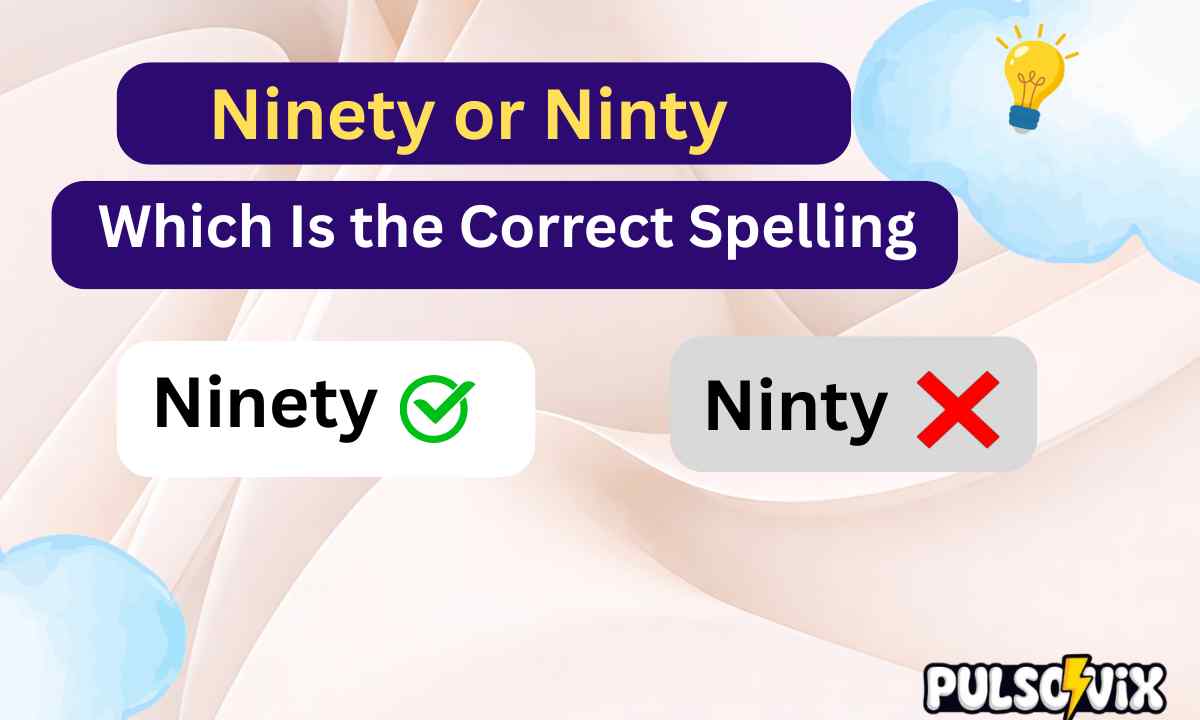

If you have ever paused mid-sentence wondering whether to write ninety or ninty, you are not alone. It is one of the most searched spelling questions in English grammar, and the answer is surprisingly straightforward — yet easy to get wrong. This guide settles the ninety or ninty debate once and for all, explains why the confusion exists, and gives you rock-solid memory tricks so you never make this mistake again.
Whether you are a student, a professional, a blogger, or someone who simply wants to write with confidence, understanding the difference between ninety and ninty will sharpen your writing and protect your credibility.
Why It’s “Ninety” and Not “Ninty”
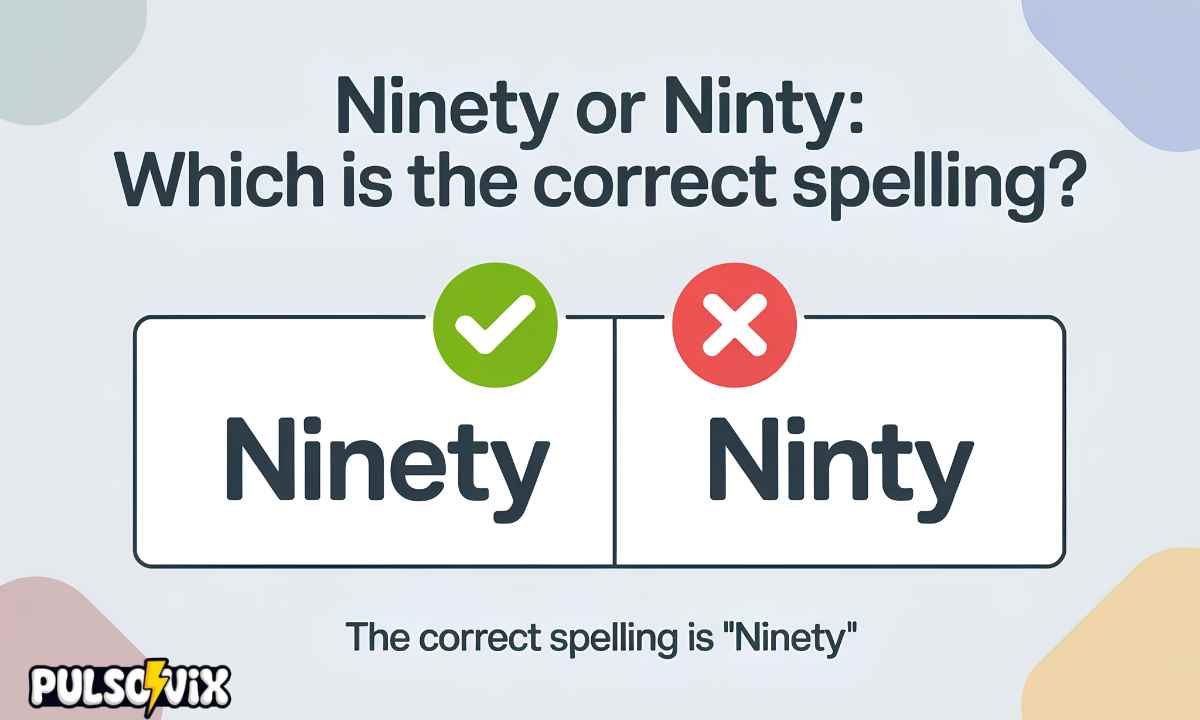
Let’s answer the key question immediately: ninety is the correct spelling. Ninty is a misspelling — it is not a real word, it does not appear in any reputable dictionary, and it has no recognized meaning in standard English.
The number 90, when written out in words, is always ninety. There are no exceptions, no regional variations, and no informal contexts where ninty becomes acceptable. Whether you are writing a formal contract, a school essay, a business email, or a casual social media post, the only correct choice is ninety.
| Spelling | Status | Meaning |
| Ninety | ✅ Correct | The number 90 (nine × ten) |
| Ninty | ❌ Incorrect | Not a word; no recognized meaning |
Understanding the Origin of “Ninety”
To understand why ninety is spelled the way it is, it helps to look at where the word actually comes from.
The word ninety has deep roots in Old English. Its ancestor is the Old English word nigontig, which was a compound of nigon (meaning “nine”) and tig (a suffix meaning “group of ten”). Over centuries, as the English language evolved through contact with Germanic dialects, Norman French, and Middle English influences, the word gradually transformed into its modern form: ninety.
This historical path explains why ninety retains the “e” from the base word “nine.” The spelling was not invented arbitrarily — it was inherited from a long chain of linguistic evolution. Other number words followed different paths, which is why English number spellings can feel inconsistent. For example:
- Four → Forty (the “u” is dropped)
- Five → Fifty (the “ve” changes to “f”)
- Nine → Ninety (the “e” is kept)
Each number word has its own historical pattern, and ninety simply follows the rule that preserves the full root word “nine.” So when you write ninety, you are actually honoring centuries of English language history.
The Common Confusion: Why People Write “Ninty”

The ninety or ninty confusion is understandable. Here are the main reasons writers reach for the wrong spelling:
1. Pronunciation Misleads the Writer
When you say the word “ninety” aloud, the “e” is essentially silent. You hear “NINE-tee”, not “NINE-eh-tee.” Because the spoken word sounds almost identical to what “ninty” would sound like, many people write what they hear rather than what the dictionary prescribes.
2. Inconsistent Number Spelling Patterns
English does not follow a single universal rule for spelling multiples of ten. Consider:
- Twenty (from “two” — but the “o” is replaced entirely)
- Thirty (from “three” — heavily transformed)
- Forty (from “four” — the “u” is dropped)
- Fifty (from “five” — “ve” becomes “f”)
- Sixty (from “six” — mostly consistent)
- Seventy (from “seven” — “-en” becomes “-en”)
- Eighty (from “eight” — relatively consistent)
- Ninety (from “nine” — the “e” is retained)
Because some numbers do drop letters when forming their tens variant (like four → forty), writers reasonably assume nine would follow the same logic. But it does not. Ninety keeps the full spelling of “nine.”
Also, read this: IGL Meaning in Text: Your Ultimate Guide to This Trending Acronym
3. Auto-Correct and Digital Shortcuts
In an era of fast typing on smartphones and keyboards, spelling errors slip through more often. Some older auto-correct systems have even accepted “ninty” without flagging it, reinforcing the wrong habit in casual digital writing.
4. The “Drop the Vowel” Rule Misapplication
English has a common spelling rule where a trailing vowel is dropped before adding a suffix — for example, “hope” becomes “hoping” (not “hopeing”). Some writers mistakenly apply this logic to “nine + ty,” dropping the “e” to get “ninty.” However, this rule simply does not apply to number formation in English.
Why Spelling Accuracy Matters
Some people dismiss spelling errors as trivial. But when it comes to professional, academic, or legal writing, a misspelling like ninty can have real consequences.
Credibility and First Impressions
When a reader spots ninty in a business proposal, resume, or formal report, it signals carelessness. Even if the content is excellent, spelling mistakes create doubt. Studies in business communication consistently show that writing errors reduce the perceived competence and trustworthiness of the author.
Legal and Financial Documents
In contracts, checks, and financial agreements, numbers are often written out in words to prevent fraud and ambiguity. Writing ninty dollars on a check instead of ninety dollars could invalidate the document or create confusion. In legal contexts, precision is not optional — it is mandatory.
Academic Writing
Students who write ninty in essays, reports, or exams risk losing marks. Academic institutions expect correct standard English, and number spelling is a basic literacy requirement.
The Digital Footprint
In the age of SEO, online publishing, and digital content, misspellings affect discoverability. Search engines index content based on the words actually written. A page that repeatedly writes ninty may miss search traffic from users correctly typing ninety.
Practical Tips to Avoid Writing “Ninty”
Knowing the correct spelling is one thing. Remembering it under pressure is another. Here are proven strategies to make ninety stick in your memory:
Tip 1: “Nine + ty = Ninety”
The simplest mnemonic is this: ninety is just “nine” with “ty” added. Write the full word “nine,” then attach “ty.” The result is always ninety. This trick works because it forces you to start from the correct root word before adding the suffix.
Tip 2: Think of “Nineteen”
Notice that both nineteen (19) and ninety (90) contain the complete word “nine.” If you already know how to spell “nineteen” — and most people do — applying the same logic to ninety becomes intuitive. Both numbers start with “nine” because both are derived from it.
Tip 3: Use Related Words as Anchors
The word family around “nine” always keeps the full spelling:
- Nine → nine
- Nineteen → nineteen
- Ninety → ninety
- Ninetieth → ninetieth
- Nineties → nineties
Every single form of the number nine preserves the original spelling. There is no version of “nine” that drops its “e” in standard English.
Tip 4: Use Grammar and Spell-Check Tools
Modern tools like Grammarly, Microsoft Word, and Google Docs will flag ninty as a spelling error. Make it a habit to run spell-check before finalizing any document. These tools are not a substitute for learning the correct spelling, but they are a reliable safety net.
Tip 5: Practice Writing It
Repetition builds memory. Write the following sentence ten times to cement the correct spelling:
“Ninety students scored above ninety percent on the ninety-question test.”
After a few rounds of deliberate practice, your brain will default to the correct spelling automatically.
The Impact of Misspellings in Real Life
Consider these real-world scenarios where writing ninty instead of ninety creates problems:
Scenario 1 — Job Application: A candidate submits a cover letter mentioning “ninty days of probation.” The hiring manager notices the error and questions the candidate’s attention to detail. The application is passed over in favor of an otherwise equal candidate.
Scenario 2 — Business Contract: A vendor writes “ninty thousand dollars” in a service agreement. The legal team flags the document for correction before signing, causing delays and eroding confidence in the vendor’s professionalism.
Scenario 3 — Blog Post: A writer publishes an article using ninty throughout. Search engines index the wrong spelling, and the article fails to rank for users searching the correct form ninety. The post underperforms despite being well-researched.
Scenario 4 — Academic Exam: A student writes “ninty percent” in a statistics essay. The professor deducts points for the spelling error. The student’s final grade drops by a small but unnecessary margin.
These scenarios are not exaggerations — they represent real consequences that flow from a single repeated misspelling.
Formal Writing vs. Casual Writing
One common question about ninety or ninty is whether the rules change depending on the context. The short answer: no. Ninty is wrong in every context. However, how you present the number 90 in writing does vary:
When to Spell Out “Ninety”
- At the beginning of a sentence: “Ninety percent of participants agreed.”
- In formal or legal writing when specifying amounts
- In creative or literary writing for stylistic effect
- When writing out ages informally: “She lived to be ninety.”
When to Use the Numeral “90”
- In technical, scientific, or statistical writing
- In tables, charts, or data-heavy content
- When paired with units of measurement: “90 degrees,” “90 mph,” “90 mg”
- In most cases involving numbers above ten, per major style guides (AP, Chicago, APA)
The key takeaway: whether you write it as the numeral 90 or the word ninety, the spelled-out version is always ninety — never ninty.
Practical Applications of “Ninety”

Understanding when and how to use ninety correctly helps in many everyday writing situations:
In Geometry: Right angles measure exactly ninety degrees. This is one of the most frequently written uses of the word in mathematics and physics.
In Time: A ninety-minute film. A ninety-second countdown. Ninety days’ notice on a lease agreement.
In Age: “My grandfather just celebrated his ninetyth birthday.”
In Percentages: “Over ninety percent of users preferred the new design.”
In Finance: “The invoice is payable within ninety days.”
In History: “The nineteen-nineties saw rapid technological change.” (Note: the plural form “nineties” is also correct for referring to decades or a person’s age range.)
Commonly Misspelled Numbers and Their Causes
The ninety or ninty confusion is not unique. English number spelling trips up even native speakers in several places:
| Number | Correct Spelling | Common Misspelling | Root Word |
| 40 | Forty | ~~Fourty~~ | Four |
| 50 | Fifty | ~~Fivety~~ | Five |
| 80 | Eighty | ~~Eiighty~~ | Eight |
| 90 | Ninety | ~~Ninty~~ | Nine |
| 12 | Twelve | ~~Tweleve~~ | — |
| 19 | Nineteen | ~~Ninteen~~ | Nine |
The pattern is consistent: when in doubt about a number word, look at the root number and understand how it evolved historically. For ninety or ninty, the root is “nine” and the correct form always preserves it.
The Role of Spelling in Communication
Language is ultimately a tool for conveying meaning clearly. When spelling breaks down, communication falters. The ninety or ninty example may seem minor, but it illustrates a broader principle: correct spelling is a form of respect for your reader.
It signals that you have taken care with your words. It reduces cognitive friction — the reader does not have to pause and puzzle over what you meant. And it maintains the shared standard that makes written communication reliable across contexts, cultures, and time.
For non-native English speakers, mastering tricky spellings like ninety demonstrates genuine command of the language. For native speakers, it is simply a mark of literacy and diligence.
The Importance of Language Consistency
One reason ninety or ninty errors persist is that writers are inconsistent. They may spell it correctly in one paragraph and write ninty in the next, especially in longer documents. This inconsistency undermines the professionalism of the whole piece.
Building a consistent habit around correct number spelling — and particularly around the ninety or ninty distinction — is easier than it sounds. A few deliberate corrections and memory techniques are all it takes to establish the right neural pathway.
Conclusion
The ninety or ninty question has one clear, unwavering answer: it is always ninety. Ninty is a misspelling with no dictionary entry, no recognized usage, and no acceptable context.
The confusion around ninety or ninty stems from how the word sounds when spoken, the inconsistency of English number spelling, and the misapplication of common spelling rules. But once you know that ninety simply adds “-ty” to the full root word “nine” — just as “nineteen” does — the correct form becomes easy to remember.
In every setting — formal or casual, digital or print, professional or personal — commit to writing ninety. Your writing will be cleaner, your credibility stronger, and your communication clearer.
The next time the ninety or ninty question crosses your mind, come back to this simple rule: Nine + ty = Ninety. That is all you need.
