

You just got a message. Two letters. “ia.” That’s it. No context, no emoji, no explanation.
Now you’re staring at your screen wondering — what does that even mean? Is it a typo? A new slang word? Something in another language? Don’t worry. You’re not alone. Millions of people search for IA meaning in text every single day, and this guide gives you every answer you need — clearly, quickly, and completely.
Whether you’re a Gen Z native, a curious parent, or someone trying to keep up with fast-moving internet slang, this article breaks down the IA meaning in text from every angle: what it means, how it’s used, where you’ll see it, and exactly how to respond. Let’s get into it.
What Does “IA” Mean in Text?
IA meaning in text is most commonly “I Agree.” It’s a two-letter shorthand that signals you’re on the same page as someone without typing out a full sentence. In a world where texts move fast and thumbs get tired, “ia” is the digital equivalent of a firm nod.
That said, IA meaning in text isn’t one-size-fits-all. The exact definition depends on context — who you’re talking to, which platform you’re on, and what the conversation is about. In some communities (particularly Muslim-majority ones), “IA” stands for “Insha’Allah” — a meaningful Arabic phrase covered later in this guide.
Here’s the short version:
IA = I Agree (most common in casual texting and social media)
The Most Common Meanings of “IA”
Before diving into examples and usage, here’s a quick-reference table of the most frequent IA meaning in text interpretations you’ll come across:
| Meaning | Context | Frequency |
| I Agree | Casual texting, social media, DMs | ⭐⭐⭐⭐⭐ Very Common |
| Insha’Allah | Muslim communities, Islamic contexts | ⭐⭐⭐⭐ Very Common |
| In Advance | Email, formal chats | ⭐⭐⭐ Moderate |
| Inactive Account | Twitter/X, gaming profiles | ⭐⭐ Less Common |
| Intelligent Assistant | Tech discussions | ⭐ Rare in casual use |
Let’s break each one down.
1. IA = I Agree (Most Common)
When someone texts you “ia,” they almost certainly mean I Agree. This is the most widely used IA meaning in text across platforms like Instagram, Snapchat, iMessage, WhatsApp, and Twitter/X.
Example:
Friend: “That movie was so overrated.” You: “ia, the hype was way bigger than the actual film.”
It’s short, casual, and expressive. No need for a full paragraph when two letters say exactly what you feel.
Similar terms: bet, facts, fr, word, IAWTC (I Agree With This Comment), ICAM (I Completely Agree with Me)
2. IA = In Advance
In professional or semi-formal settings, “IA” can stand for In Advance — typically used in emails or structured messages to express thanks or a request before the fact.
Example:
“Thanks IA for sending over the report by Friday.”
You’ll see this more in business communication than in personal texting. If someone uses “IA” this way in a casual conversation, it may cause some confusion — which is why context matters so much when decoding IA meaning in text.
3. IA = Inactive Account
On platforms like Twitter/X and in gaming circles, “IA” is sometimes used to indicate an Inactive Account — a profile that hasn’t posted or engaged in a while.
Example:
“Sorry for the slow replies, I’ve been IA for two weeks.”
This usage is more common in fandom communities, gaming forums, and creator spaces where followers track posting schedules.
4. IA = Intelligent Assistant
In tech-forward discussions, “IA” occasionally refers to an Intelligent Assistant — a broader term that encompasses AI tools like Siri, Alexa, or virtual chat agents. This usage is niche and mostly appears in professional tech writing or developer forums.
If you’re in a general text conversation and someone says “IA,” this is almost certainly not what they mean. Stick with “I Agree” as your default read of IA meaning in text.
How “IA” Is Used in Real Conversations
Understanding IA meaning in text is one thing. Seeing it in action is another. Here’s how the abbreviation plays out across different environments.
Friends & Casual Texting
Between friends, “ia” is zero-pressure agreement. It’s warm, easy, and keeps the conversation moving.
Example:
Alex: “We should stop making plans we never follow through on.” Jordan: “ia lmao we’re both terrible at this”
The tone here is light. “ia” doesn’t feel cold or dismissive because both people already share easy rapport.
Instagram & Snapchat
On Instagram comments and Snapchat DMs, “IA” appears frequently under posts, reels, and stories. It shows public support or agreement in a fast, thumb-friendly format.
Example:
Caption: “Iced coffee hits different in summer ☀️” Comment: “IA no cap”
Social media moves fast. Short replies dominate. “ia” fits perfectly in this environment because attention spans are short and validation is quick.
Dating Apps
On apps like Tinder, Bumble, or Hinge, the tone matters a lot. Sending just “ia” as a standalone reply can feel flat — it doesn’t build attraction or show personality. In this context, the IA meaning in text still signals agreement, but it’s wiser to add a little extra warmth.
Better approach:
Instead of just “ia,” try “ia honestly, that’s my vibe too 😄”
Gaming & Online Communities
In Discord servers, Reddit threads, and gaming forums, “ia” is used to align with someone’s opinion during debates or discussions.
Example:
User1: “The old map was way better than this new one.” User2: “ia, the developers really dropped the ball”
This is a low-key but clear form of digital agreement. Short. Direct. Efficient.
Work or Professional Chat
In Slack or Microsoft Teams, using “ia” can feel too casual or ambiguous. A manager or colleague might not recognize it or could misread the IA meaning in text as a typo. In professional settings, spelling out “I agree” or “Noted, I agree with this approach” is always the safer call.
Is “IA” Rude, Flirty, or Offensive?
This question comes up a lot, and the answer depends almost entirely on tone and context.
Is it rude?
Not inherently. But “ia” sent as a one-word reply to a long, emotional message can feel dismissive — as if you barely read what was shared. If someone pours their heart out and you reply “ia,” the brevity itself becomes the problem, not the word.
Also read this Blog: JP Meaning in Text: What It Really Means in (2026 Updated) (Full Breakdown You Need)
Is it flirty?
No. “IA” on its own carries zero romantic charge. It’s neutral agreement. If someone is using it in a flirty way, the flirtation comes from the surrounding conversation, not the word itself.
Is it offensive?
Not at all, unless the context makes it feel sarcastic or passive-aggressive. In most cases, IA meaning in text is completely benign.
Tone Psychology
Here’s an important communication insight: in text, short replies feel different from spoken short replies. When you say “I agree” out loud, your face, tone, and body language fill in the warmth. In text, all of that disappears. So while “ia” is perfectly fine in high-energy casual chats, in slower, more serious conversations it can read as cold or low-effort. Reading the room — and matching the energy of the conversation — is always the smart move.
IA Meaning in Text Islam
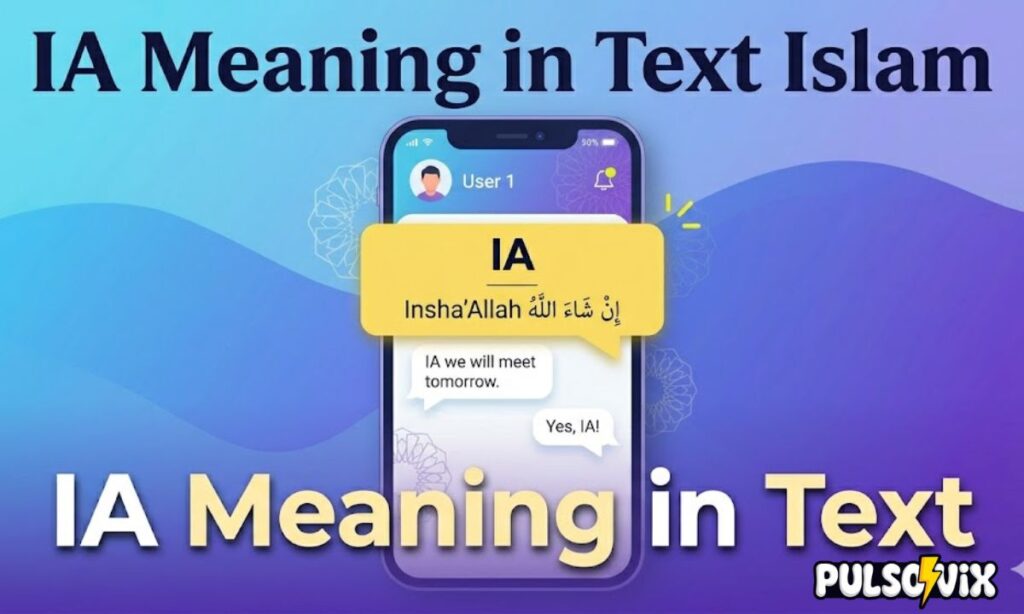
This is one of the most searched sub-topics around IA meaning in text, and for good reason.
In Muslim communities — including large South Asian, Middle Eastern, and Southeast Asian online populations — IA stands for Insha’Allah (sometimes spelled InshaAllah or In Sha Allah). This Arabic phrase appears in Surah Al-Kahf (18:23–24) in the Quran and translates to “If Allah wills” or “God willing.”
Muslims use Insha’Allah when speaking about any future plan, hope, or action — acknowledging that outcomes belong to Allah, not to human certainty.
Example:
“I’ll finish the assignment by tomorrow, IA.” “We’ll meet at the event, IA.”
For practicing Muslims, saying Insha’Allah (or its shortform “IA”) is an act of faith and obedience, not just a casual expression. The phrase is deeply embedded in everyday speech across Urdu, Arabic, Turkish, Malay, Swahili, and many other languages spoken by Muslim communities globally.
Key distinction: If you’re texting someone from a Muslim-majority background and they say “IA,” there’s a strong chance they mean Insha’Allah, not “I Agree.” Context — including the subject of the conversation and the person’s background — will help you tell the difference.
Some Islamic scholars note that while abbreviating “InshaAllah” to “IA” is widely understood, writing the full phrase is spiritually preferable. Regardless, the abbreviation is in widespread use across digital communication worldwide.
How to Respond When Someone Says “IA”
Now that you know the IA meaning in text, how do you actually reply when someone sends it to you? Here are response options by situation.
Casual Replies
- “Right?? Exactly how I feel.”
- “Glad we’re on the same page lol”
- “Facts, I’ve been saying this”
- “Finally someone gets it 😭”
Funny Replies
- “IA but also… debate me”
- “ia ia ia (said in robot voice)”
- “Okay we’re the same person at this point”
- “Two smart people confirmed 🧠”
Neutral Replies
- “Good, we’re aligned then.”
- “Glad to hear that.”
- “Same.”
- “Cool, noted.”
Professional Replies
- “Glad we’re aligned on this.”
- “Agreed — I’ll move forward with that approach.”
- “Thanks for confirming. I’ll proceed.”
IA Meaning in Social Media
Across social platforms, the IA meaning in text takes on a slightly different flavor depending on where you are.
| Platform | How “IA” Is Typically Used |
| Comment agreement on posts/reels | |
| Snapchat | Quick DM reply to show you’re on board |
| Twitter/X | Replying to threads or quote tweets to agree |
| TikTok | Commenting to validate creator opinions |
| Discord | Chat agreement in server discussions |
| Shorthand in comment threads | |
| Group chats, casual one-on-one messages |
On platforms like Twitter and TikTok, where hot takes and opinions fly fast, “IA” in a comment is essentially a public vote of confidence. It shows you stand behind the original post without needing to elaborate. On more private platforms like WhatsApp or iMessage, it signals agreement in an ongoing conversation.
Common Misunderstandings About “IA”
Even once you know the basics of IA meaning in text, misreads still happen. Here are the most common ones.
1. Thinking It’s a Typo
Many people assume “ia” is a misspelling of “is” or “in” or something else. It’s not. It’s intentional internet slang with a clear and consistent meaning.
2. Confusing It with AI
“IA” and “AI” are not the same thing. AI (Artificial Intelligence) is a completely separate acronym. Confusing the two leads to very different interpretations. IA meaning in text is about agreement (or Insha’Allah), not technology.
3. Assuming It’s Always “In Advance”
Some people familiar with professional abbreviations default to reading “IA” as “In Advance.” In texting and social media, this is almost always wrong. The dominant IA meaning in text is “I Agree.”
4. Reading It as Passive-Aggressive
A short “ia” after a disagreement might feel sarcastic or passive-aggressive, but in most cases it’s not. Unless the tone of the whole conversation is hostile, assume straightforward agreement.
Similar Slang Terms You Should Know
If you’re getting comfortable with IA meaning in text, it helps to know the surrounding slang ecosystem. Here are related terms that carry similar energy:
| Term | Meaning | Example |
| Fr / FR | For Real (strong agreement) | “fr that was the worst episode ever” |
| Facts | I agree, that’s true | “Facts, no cap” |
| Bet | Okay / agreed | “Bet, I’ll be there at 8” |
| Word | I agree / exactly | “Word, same tbh” |
| IAWTC | I Agree With This Comment | Used in forums/threads |
| ICAM | I Completely Agree with Me | Humorous self-agreement |
| NGL | Not Gonna Lie (honest take) | “NGL ia with you on this” |
| Lowkey | Secretly, kind of | “Lowkey ia with that” |
| No cap | No lie / for real | “ia no cap” |
| Slay | Excellent / I approve | Different vibe but expresses approval |
When You Should Avoid Using “IA”
Knowing the IA meaning in text also means knowing when NOT to use it.
1. Professional Emails
An email to your boss or a client is not the place for “IA.” It can seem unprofessional, ambiguous, or even disrespectful. Spell everything out clearly in formal communication.
2. Cross-Cultural Chats
Not everyone knows internet slang. If you’re chatting with someone from a different country, age group, or background, “IA” may create confusion. In international chats, clarity always wins over brevity.
3. Emotional Conversations
If someone shares something painful — a loss, a personal struggle, a difficult experience — replying with just “ia” feels cold and dismissive, even if you genuinely agree with what they’ve shared. Match the emotional weight of the conversation.
4. Long Discussions
If someone writes five paragraphs making a thoughtful argument, replying with “ia” feels lazy. It signals you didn’t fully engage. Even if you agree completely, say a little more — it keeps the conversation alive and shows respect.
Conclusion
Now you know the full picture of IA meaning in text. In most contexts, it simply means “I Agree” — a fast, casual way to show you’re on the same page. In Muslim communities, IA meaning in text refers to Insha’Allah, an Arabic phrase that carries deep spiritual weight alongside everyday conversational use. In more formal or technical settings, it can mean “In Advance” or even “Inactive Account.”
Understanding IA meaning in text isn’t just about decoding two letters — it’s about reading context, respecting tone, and communicating smarter. Whether you’re texting a friend, commenting on Instagram, chatting in a Discord server, or messaging a Muslim colleague, you now know exactly what “ia” means and how to respond to it.
The next time those two letters pop up on your screen, you won’t have to pause. You’ll just get it.
