
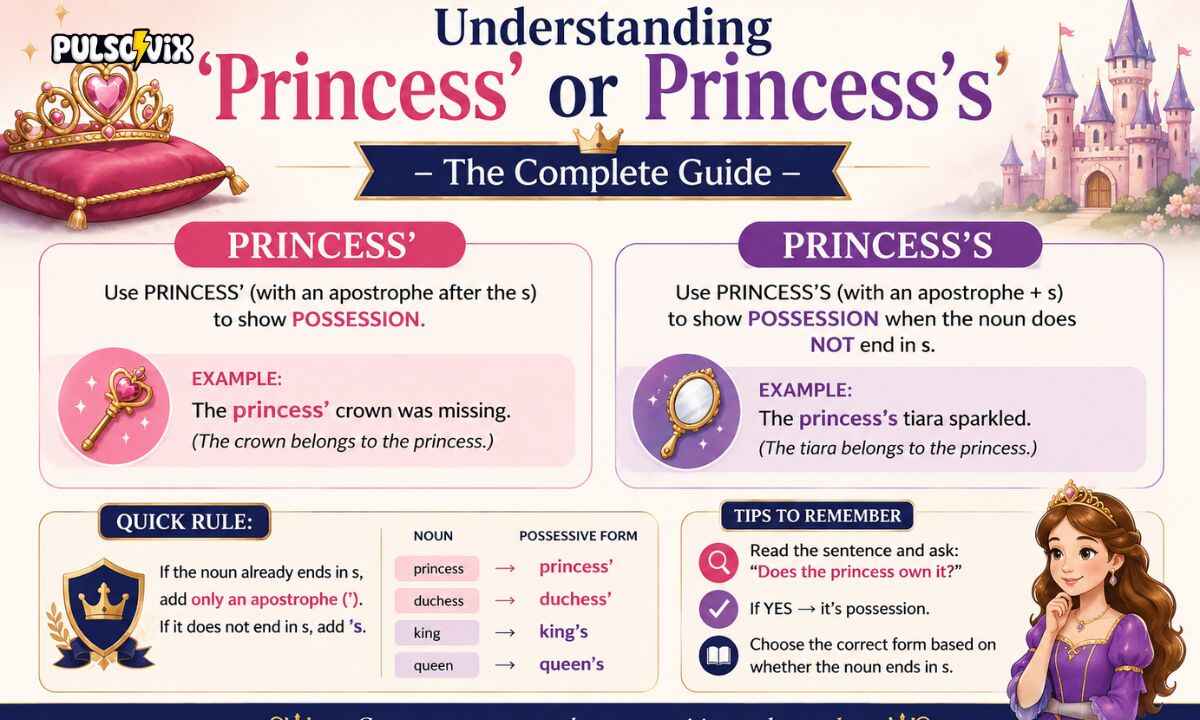

If you’ve ever paused mid-sentence wondering whether to write the princess’s crown or the princess’ crown, you’re not alone. This tiny apostrophe placement trips up even experienced writers. Understanding “Princess’ or Princess’s” is not just about memorizing a rule — it’s about grasping how English possessives work at their core.
In this complete guide, you’ll learn the singular and plural forms of “princess,” how possessive apostrophes function, what major style guides say, and how to apply these rules confidently in everyday writing. Whether you’re crafting a professional email, writing a blog post, or editing a novel set in a royal court, this guide has you covered.
Singular and Plural Forms: A Refresher
Before jumping into possessives, it helps to understand the base forms of the word. The noun “princess” follows standard English noun patterns, and getting this right sets the foundation for everything else.
Singular Form
The singular form is simply princess. It refers to one royal female, one title-holder, or one fictional character. There’s no complexity here — just one princess.
The princess walked into the ballroom.
Plural Form
The plural form is princesses. When you’re talking about more than one princess, you add -es because the word already ends in -s. This is standard English spelling for words ending in -ss.
The princesses gathered for the royal ceremony.
Understanding this distinction matters because the plural form directly affects how the possessive apostrophe is placed.
Understanding Possessive Forms
Possessive forms in English show ownership or association. You create them by adding an apostrophe, sometimes followed by an s, to a noun. The confusion with “princess” arises because the word already ends in -s, which makes writers unsure whether to add another s after the apostrophe.
Here’s the short answer: the possessive form you use depends on whether you’re talking about one princess or multiple princesses, and which style guide you follow.
Singular Possessive Form
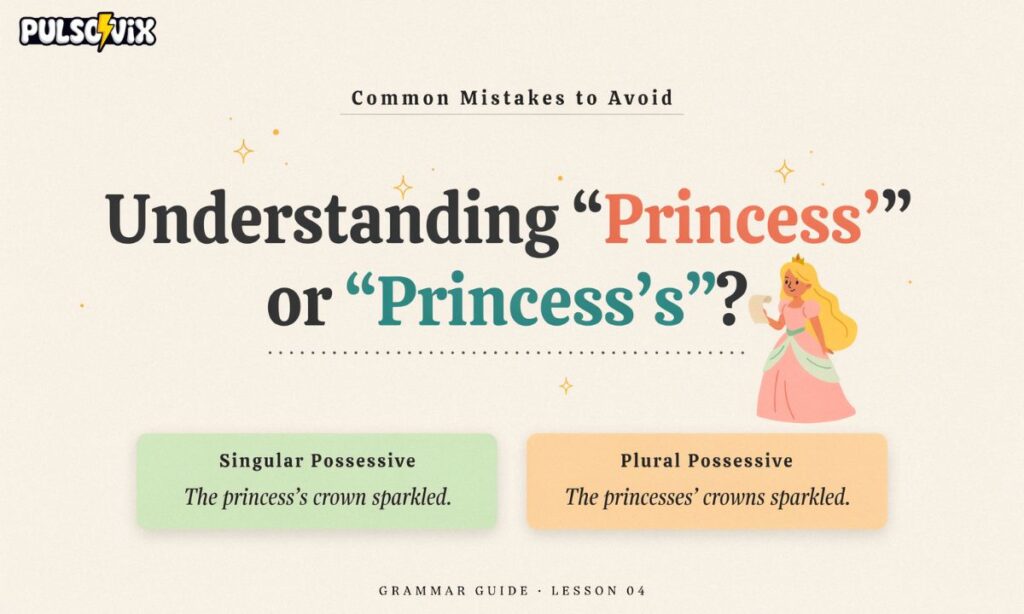
When you want to show that something belongs to one princess, you need the singular possessive. The standard rule in modern American English is to add apostrophe + s (‘s) to the end of the word — even when it already ends in s.
Correct singular possessive: princess’s
- The princess’s crown glittered under the chandelier.
- Everyone admired the princess’s composure during the speech.
- The princess’s arrival was announced at noon.
The Chicago Manual of Style, one of the most widely used editorial authorities, firmly supports this rule. It states that the possessive of most singular nouns — including those ending in s — is formed by adding ‘s. So princess’s is always correct under CMOS.
Some older texts and certain style guides allow princess’ (apostrophe only) for singular possessives of nouns ending in s, but this usage is becoming increasingly uncommon in mainstream writing.
Plural Possessive Form
When multiple princesses own or are associated with something, you use the plural possessive. Since the plural form is princesses (already ending in -s), you simply add an apostrophe after the final s — no additional s is added.
Correct plural possessive: princesses’
- The princesses’ gowns were designed by the royal tailor.
- The princesses’ duties include attending state dinners and diplomatic events.
- All three kingdoms celebrated the princesses’ achievements.
This rule is consistent across all major style guides — both Chicago and AP agree that plural nouns ending in s take only an apostrophe.
Also, read this blog: Ninety or Ninty: Which Is the Correct Spelling? (Full Guide)
Why the Apostrophe Placement Matters
A misplaced apostrophe doesn’t just look wrong — it changes the entire meaning of a sentence.
Consider the difference:
| Sentence | Meaning |
| The princess’s jewels were stolen. | One princess lost her jewels. |
| The princesses’ jewels were stolen. | Multiple princesses lost their jewels. |
That single apostrophe shift moves ownership from one person to many. In a legal document, a news article, or a formal report, this distinction could be critically important. Even in casual writing, the wrong placement creates confusion and undermines your credibility as a writer.
Common Confusion: Understanding “Princess’ or Princess’s?”
This is the core question most writers wrestle with. Both forms appear in published writing, which is exactly what causes the confusion. Let’s break it down clearly.
The Rule
- Princess’s → singular possessive (one princess owns something)
- Princesses’ → plural possessive (multiple princesses own something)
- Princess’ → an older or stylistically specific singular possessive (used in AP Style contexts or British English)
In standard American English, princess’s is the correct and preferred singular possessive. Most grammar authorities, including the Chicago Manual of Style and Strunk & White’s The Elements of Style, support adding ‘s to singular nouns ending in s.
Breaking Down the Misconceptions
Misconception 1: “Adding ‘s after a word ending in s is a typo.” It’s not. Words like boss’s office, class’s schedule, and princess’s crown are all grammatically correct. The double-s appearance is intentional.
Misconception 2: “Princess’ is always wrong.” Not entirely. In AP Style, used widely in journalism, princess’ can appear in certain contexts — particularly when the following word also starts with s (e.g., princess’ scepter). However, for general and academic writing, princess’s is preferred.
Misconception 3: “The rule is the same regardless of style guide.” It isn’t. Chicago says always add ‘s for singular nouns. AP Style allows dropping the extra s for proper names ending in s, and some editors extend this to common nouns too. Knowing your target style guide is essential.
Examples of Possessive Forms in Context
Seeing possessives in real sentences is the fastest way to internalize the rules. Here are practical examples across different scenarios.
Singular Possessive in Everyday Use
- The princess’s speech moved the crowd to tears.
- Have you read the princess’s memoir?
- The kingdom awaited the princess’s decision on the treaty.
- The designer revealed the princess’s wedding gown collection.
- We toured the princess’s private garden.
Each sentence refers to one princess and uses princess’s to show ownership.
Plural Possessive in Everyday Use
- The princesses’ portraits were hung in the grand hall.
- The council debated the princesses’ requests.
- Journalists covered the princesses’ joint charity event.
- The princesses’ combined influence shaped national policy.
Each sentence involves multiple princesses, so the apostrophe follows the plural princesses.
Quick Reference Table: Singular vs. Plural Possessive Forms
| Form | Word | Example |
| Singular | princess | The princess wore a crown. |
| Singular Possessive | princess’s | The princess’s crown was gold. |
| Plural | princesses | The three princesses arrived. |
| Plural Possessive | princesses’ | The princesses’ crowns were gold. |
Real-Life Applications
Grammar rules matter most when applied in real contexts. Here’s how to use princess’s and princesses’ correctly in professional and everyday communication.
Email Communication
Proper possessive use in emails reflects attention to detail and professionalism.
Correct:
Subject: Royal Event Update Hi Sarah, please confirm that the princess’s itinerary has been finalized. The princesses’ joint appearance is scheduled for 3 PM.
Incorrect:
Please confirm that the princess’ itinerary has been finalized. (In formal American English, this reads as an error.)
Social Media Posts
Social platforms reward clear, engaging writing. A grammar error in a post about royalty can distract from your message.
Correct:
“Just finished reading about the princess’s groundbreaking environmental initiative. Inspiring! 🌿”
“The princesses’ coordinated outfits at the summit were stunning — royal fashion at its best.”
Using the correct form signals that you care about your craft, even in a 280-character tweet.
Common Mistakes to Avoid Understanding “Princess’ or Princess’s?”
Even careful writers stumble on these. Watch out for the following errors:
- Using princess’ in formal writing when your style guide (Chicago, MLA, APA) requires princess’s
- Using princess’s when referring to multiple princesses — the plural possessive is always princesses’
- Omitting the apostrophe entirely — writing princesss or princesscrown is never correct
- Confusing plural with possessive — princesses (plural, no possession) is different from princesses’ (plural possessive)
- Inconsistency within a single document — switching between princess’s and princess’ in the same piece confuses readers
The safest approach for most writers: stick with princess’s for singular and princesses’ for plural, and you’ll be correct in nearly every context.
Why Grammar Matters
Some writers wonder whether these small distinctions really matter. They do — and here’s why.
Clarity and Precision
The difference between princess’s and princesses’ isn’t cosmetic. It signals whether one or many people hold ownership. In legal writing, academic papers, journalism, and business documents, this distinction can change the interpretation of a sentence entirely. Clear grammar prevents ambiguity and protects your meaning.
Professionalism in Writing
Misplaced apostrophes signal carelessness. Whether you’re submitting a cover letter, publishing a blog post, or writing a children’s book, grammatical accuracy affects how readers perceive you. Readers may not consciously notice correct grammar, but they almost always notice errors — and errors erode trust.
Style Guide Comparisons
Different style guides handle possessives of nouns ending in s in slightly different ways. Here’s a clear comparison:
| Style Guide | Singular Possessive | Plural Possessive | Example |
| Chicago Manual of Style | Add ‘s always | Add ‘ only | princess’s / princesses’ |
| AP Stylebook | Add ‘s for common nouns; ‘ for proper nouns ending in s | Add ‘ only | princess’s / princesses’ |
| APA Style | Add ‘s always | Add ‘ only | princess’s / princesses’ |
| MLA Style | Add ‘s always | Add ‘ only | princess’s / princesses’ |
| British English | Often add ‘ only | Add ‘ only | princess’ / princesses’ |
Key takeaway: For the vast majority of English writing in academic, professional, and creative contexts, princess’s is the correct singular possessive. Only in journalism (AP) or British English contexts would you commonly see princess’ as the singular.
Tips for Mastering Possessive Grammar
Struggling to remember the rules? These practical strategies will help them stick.
- Ask yourself: is it one or many? If it’s one princess, use princess’s. If it’s multiple, use princesses’.
- Say it out loud. Native English speakers naturally say “princess-iz” for the possessive. If you’re adding a spoken syllable, you likely need ‘s.
- Remember the two-step rule: Form the plural first (princesses), then add only an apostrophe for the possessive (princesses’).
- Check your style guide. If you’re writing for publication, know whether your editor follows Chicago, AP, or another standard.
- Use a grammar tool as a safety net. Tools like Grammarly or ProWritingAid can catch apostrophe misuse, though they don’t replace understanding the underlying rule.
- Create a personal reference sheet. Jot down the four forms — princess, princess’s, princesses, princesses’ — and keep it nearby when editing.
How Apostrophes Shape Meaning in Sentences
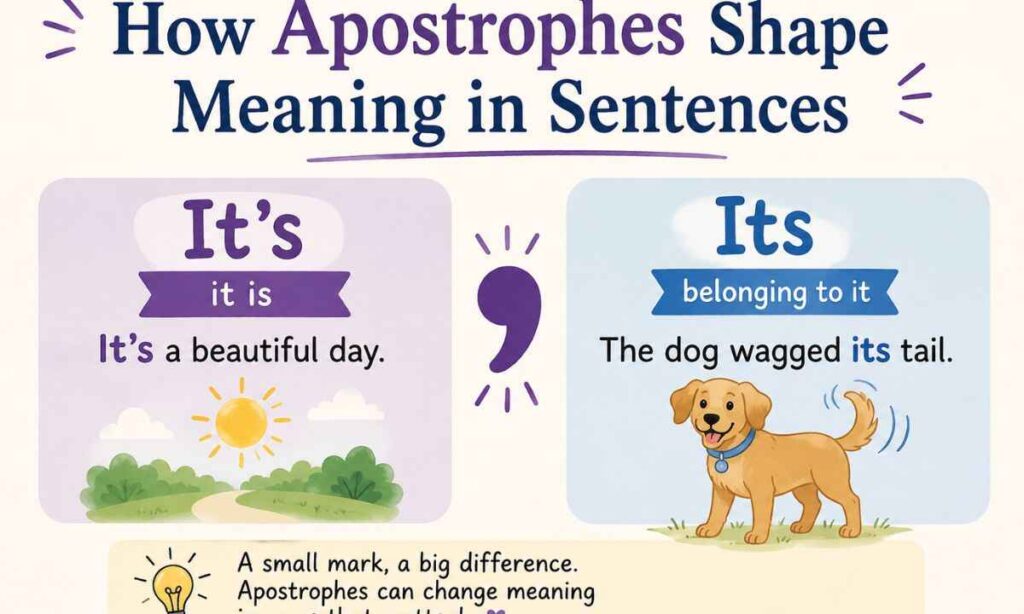
The apostrophe is one of the most powerful punctuation marks in English precisely because such a small symbol carries so much information. In the word princess’s, the apostrophe signals:
- That the noun is in possessive (not plural) form
- That ownership belongs to one entity
- That the word following it is owned or associated with that entity
Shift the apostrophe to princesses’ and suddenly you’ve communicated that the owner is a group. No additional words needed. That’s the elegance of apostrophe placement — and also why errors in its use are so disruptive to readers.
Think of the apostrophe as a shortcut. Instead of writing the crown that belongs to the princess, you write the princess’s crown. Instead of the gowns that belong to the princesses, you write the princesses’ gowns. These contractions of meaning are only accurate if the apostrophe is in the right place.
Why Writers Struggle with Possessive Nouns Ending in S
The root of the confusion lies in how English evolved. Historically, possessives were formed differently, and the ‘s ending was a contraction of an older genitive form. When a word already ends in s, the instinct is to avoid “doubling up” — it feels redundant or awkward to write princess’s.
But English grammar doesn’t always follow intuition. The ‘s in a possessive isn’t the same s as the one that ends “princess.” They serve different grammatical functions. Recognizing this distinction is the key to writing princess’s without hesitation.
Additionally, regional variation plays a role. British English is more permissive about using princess’ (apostrophe only) for singular possessives, while American English leans firmly toward princess’s. Writers who read widely across both traditions may internalize conflicting patterns without realizing it.
The Role of Possessive Grammar in Professional Communication
In professional settings, possessive grammar is a marker of attention to detail. Editors, hiring managers, professors, and publishers notice errors that casual readers might overlook. A report that reads the princess’ approval was needed instead of the princess’s approval was needed may seem like a minor issue — but in competitive environments, it contributes to an impression of carelessness.
More importantly, possessive errors can create genuine ambiguity. Imagine a legal document discussing the princesses’ estates (belonging to multiple) versus the princess’s estate (belonging to one). The financial and legal implications differ significantly. In professional communication, clarity is not a nicety — it’s a necessity.
Adopting consistent, style-guide-appropriate possessives signals that you’re a precise thinker and a careful communicator. That impression carries real value in business writing, academic work, and journalism.
Conclusion
Understanding “Princess’ or Princess’s” comes down to three core principles: know whether you’re writing about one or many, understand your style guide’s preference, and place the apostrophe accordingly.
To recap:
- princess’s = singular possessive (one princess owns something) — preferred in Chicago, APA, MLA, and most American English contexts
- princesses’ = plural possessive (multiple princesses own something) — consistent across all major style guides
- princess’ = singular possessive used in older or British English contexts, or AP Style in limited cases
The good news? Once you understand the logic behind the rule, it becomes intuitive. You’re not memorizing an exception — you’re applying a consistent principle: singular nouns, including those ending in s, take ‘s; plural nouns ending in s take only ‘.
Keep this guide bookmarked, refer to the quick reference table when you’re unsure, and soon you’ll write possessives with complete confidence — whether you’re describing a princess’s crown or a kingdom full of princesses’ ambitions.
