
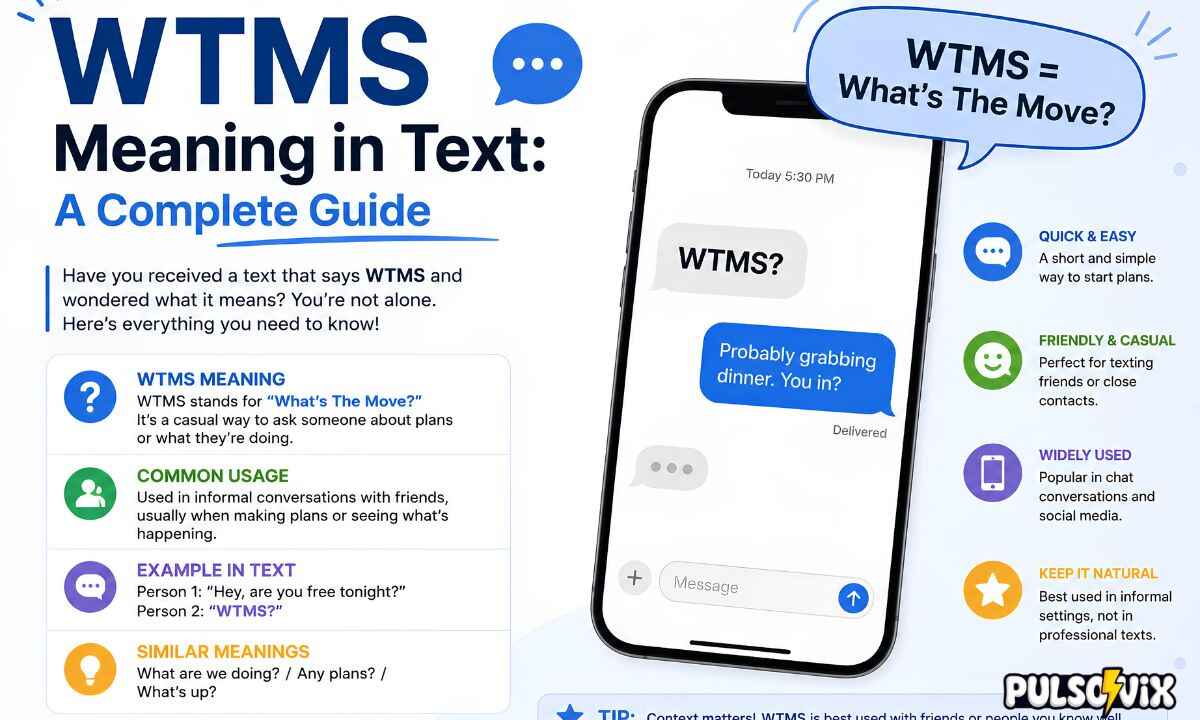

You’re scrolling through your messages, and someone drops “WTMS” out of nowhere. You freeze. You re-read it. Still nothing. If that sounds familiar, you’re not alone — this acronym confuses a lot of people, and for good reason: it has more than one meaning depending on who’s sending it and where.
This guide breaks down the WTMS meaning in text from every angle — its definition, origins, usage across platforms, how to respond, and when it crosses a line. By the end, you’ll know exactly what WTMS means and how to use it like a native.
Definition & Meaning
WTMS is a texting acronym that primarily stands for “What’s the Move, Sis?” It’s a casual, friendly way of asking someone about their plans — essentially the slang version of “What are you up to?” or “What are we doing tonight?”
The phrase is made up of two common elements in modern internet slang:
- “What’s the move?” — a casual question about plans or next steps
- “Sis” — a term of endearment, used loosely for any close friend regardless of gender
Importantly, “Sis” in this context doesn’t always refer to a sister or a female. It’s borrowed from AAVE (African American Vernacular English) and is used broadly as a friendly address within a close circle.
However, WTMS has a secondary meaning that surfaces in flirty or suggestive contexts: “What That Mouth Do?” This meaning is sexually suggestive and is generally only appropriate between couples, crushes, or in clear humor/meme contexts.
Quick Reference Table
| Acronym | Full Form | Context |
| WTMS | What’s the Move, Sis? | Casual texting, friend groups, social media |
| WTMS | What That Mouth Do? | Flirty DMs, romantic contexts, memes |
| WTMS | What’s the Most Stupid? | Rare; used as inside joke on Snapchat |
| WTMS | Web-based Text Messaging Service | Technical/business contexts (uncommon in chat) |
The vast majority of everyday usage refers to the “What’s the Move, Sis?” meaning. Context and emoji are your biggest clues — a 😊 points to the friendly version; a 😏 almost always signals something flirty.
Examples in Use
Seeing WTMS in action makes its meaning instantly clear. Here are real-world examples across different tones:
Casual / Friendly:
- “Friday’s finally here — WTMS tonight?”
- “Hey WTMS after school? Tryna link.”
- “Group chat checking in: WTMS this weekend?”
Flirty:
- “Saw your story… WTMS 😏”
- “You look amazing in that pic. WTMS?”
Humorous / Meme:
- “You said you were a good cook. WTMS then? 👀”
- “Just bought a new blender. WTMS 😂”
Each example shows how the same four letters can carry completely different energy depending on tone, emoji, and relationship.
Also, read this blog: Ninety or Ninty: Which Is the Correct Spelling? (Full Guide)
Background & History
The WTMS meaning in text didn’t appear overnight. It grew out of early 2010s internet culture, particularly through Black Twitter and Vine, where short, punchy phrases got abbreviated for speed and style.
“What’s the move?” had already been a spoken phrase in casual American English for years before texting shortened it further. As smartphones took over and messaging apps exploded in popularity, full phrases got trimmed into acronyms to keep conversation flowing without losing momentum.
By the mid-2010s, “Sis” had become a widespread term of affection across social media, thanks largely to its deep roots in AAVE and its adoption by LGBTQ+ communities online. The merger of “What’s the move?” and “Sis” into WTMS was a natural evolution.
By 2023–2025, WTMS had become one of the most searched texting abbreviations, largely because people kept receiving it in random DMs and couldn’t decode it. Platforms like TikTok and Snapchat accelerated its spread dramatically across age groups and regions.
Usage in Different Contexts
1. Texting & Social Media
In personal texts and group chats, WTMS almost always carries the friendly “What’s the Move, Sis?” meaning. It’s warm, quick, and signals that you want to make plans without a lot of back-and-forth.
On Instagram Stories, TikTok captions, and Snapchat, the term shows up in two forms:
- Public posts/captions: Usually means “what’s going on / what are you planning?”
- DMs (especially with 😏 or 🔥): The flirty secondary meaning tends to surface
The beauty of WTMS in online communication is its flexibility. You can use it to ask about dinner plans, weekend trips, or just check in — all in four letters.
2. Gaming Communities
WTMS has carved out its own niche in gaming culture, where quick coordination is everything. Players often drop it in Discord servers, game lobbies, or mid-match chats to ask about strategy or the next move.
Common gaming uses include:
- “We just lost that round — WTMS? Ranked or casual?”
- “Server’s up. WTMS, squad?”
- “Down 3-1. WTMS coach?”
Here, “Sis” sometimes gets replaced by team-specific terms, but the core meaning stays the same — it’s about figuring out the next step fast.
3. Dating Apps (Tinder, Bumble)
On dating apps, WTMS functions as both a casual conversation starter and a subtle gauge of interest. Because dating app conversations can feel stiff or scripted, dropping a casual “WTMS this weekend? 😏” injects playfulness and signals spontaneity.
Used correctly, it reads as confident and low-pressure. Used too early or with someone unfamiliar with Gen Z slang, it can cause genuine confusion. Match the energy of whoever you’re talking to before going full slang mode.
Common Misconceptions
Several myths float around about what WTMS means. Here’s what actually gets it wrong:
Misconception 1: WTMS means “What’s the matter, sis?” This is the most common mix-up. WTMS is about plans, not problems. “What’s the matter?” is a concern-based question; WTMS is an excitement-based one.
Misconception 2: “Sis” makes it gender-specific Many people assume WTMS is only used between women or directed at women. In reality, “Sis” is used universally — for close friends of any gender — in modern slang.
Misconception 3: It’s a secret teen code Adults use WTMS casually too. It’s not restricted to teenagers, though Gen Z and younger Millennials use it most frequently.
Misconception 4: It always has a flirty meaning The flirty “What That Mouth Do?” interpretation applies in specific contexts only. The vast majority of WTMS usage is completely platonic and plan-oriented.
Similar Terms & Alternatives
If you’re navigating the world of casual texting slang, WTMS has plenty of close cousins. Here’s how they compare:
| Slang | Stands For | Vibe |
| WTM | What’s the Move? | Casual, plan-focused |
| WYD | What You Doing? | Casual check-in |
| WYA | Where You At? | Location + plans |
| HMU | Hit Me Up | Open invite to reach out |
| LMK | Let Me Know | Waiting for confirmation |
| IRL | In Real Life | Contrast to online |
| DTMS | Down to Make Something? | Creative communities (rare) |
WTMS sits in the same family as WTM and WYD but adds a warmer, more personal tone with the “Sis” element. It’s slightly more affectionate than a plain “WTM” and implies a closer relationship with the recipient.
How to Respond to WTMS
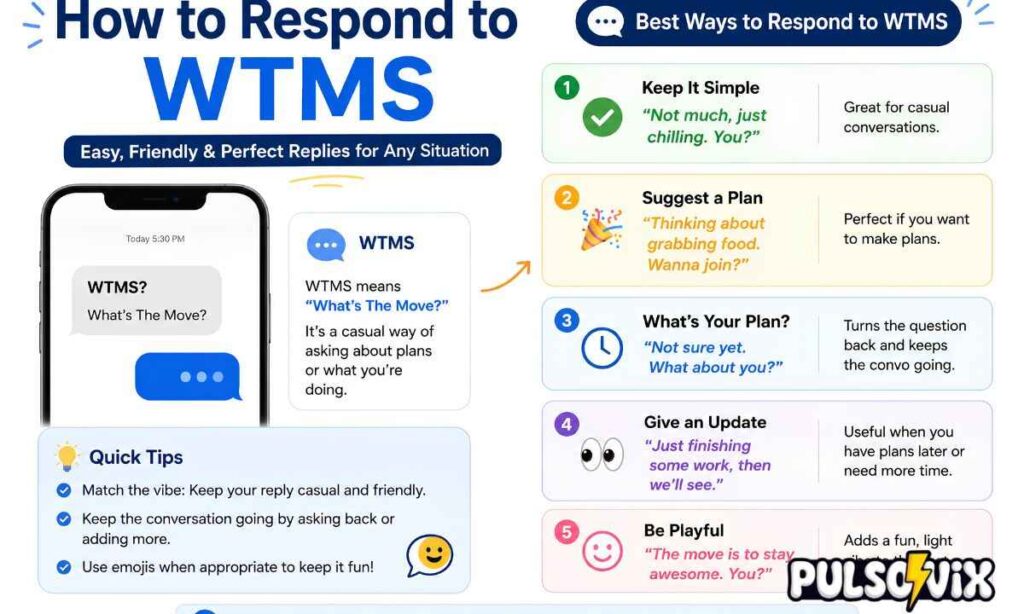
The right response depends entirely on the context and tone. Here’s a simple breakdown:
If it’s the friendly “What’s the Move, Sis?” version:
- Share your plans: “Nothing yet — thinking dinner and a movie. You in?”
- Suggest something: “WTMS on going to that new place downtown?”
- Be honest if you’re free: “No plans yet, what are you thinking?”
If it’s the flirty “What That Mouth Do?” version:
- Play along (if comfortable): “You’re bold 😂 lol”
- Deflect with humor: “Sandwiches. I make great sandwiches.”
- Shut it down clearly: “Not really my vibe, but what’s actually going on with you?”
You never owe anyone a flirty response. If WTMS makes you uncomfortable in that context, a simple redirect or no response is completely valid.
Regional & Cultural Differences
WTMS usage isn’t uniform across the world. Its meaning and reception shift depending on location and cultural background.
United States: WTMS is most commonly used in its social planning sense. It’s especially prevalent in urban communities, among Gen Z, and in online spaces rooted in AAVE and Black internet culture.
United Kingdom: Less commonly used, and when it is, it may cause more confusion. UK users are more likely to use “WTM” without the “Sis” component.
Australia & Canada: Used occasionally among younger demographics familiar with American internet culture, but not yet mainstream slang in those countries.
Non-English Speaking Countries: WTMS is largely limited to English-language platforms but appears in international gaming communities where English is the common language.
The cultural roots of WTMS — particularly in AAVE — are worth acknowledging. Much of modern internet slang originates in Black culture, and using it comes with an implicit nod to that origin, whether users realize it or not.
Is WTMS Offensive?
Generally speaking, WTMS is not offensive in its “What’s the Move, Sis?” form. It’s a friendly, informal expression with no inherently harmful content.
The “What That Mouth Do?” meaning is a different matter. It’s sexually suggestive and can absolutely feel inappropriate or harassment-adjacent if sent to the wrong person, in the wrong context, or without established mutual comfort. Sending it to a coworker, acquaintance, or someone you barely know is a significant misstep.
Rule of thumb:
- Safe with friends, close peers, or romantic partners (with clear mutual tone)
- Risky with strangers, new matches, or casual acquaintances
- Off-limits in professional or formal settings — full stop
Professional Use?
Short answer: No.
WTMS has no place in professional emails, Slack messages to clients, LinkedIn communication, or workplace chats with people you don’t know well. It’s strictly a personal-life, casual-conversation phrase.
The only narrow exception might be a very casual internal Slack channel among close colleagues who regularly communicate with informal language — and even then, proceed carefully. The safest move is always to spell out what you mean in professional settings.
Understanding WTMS and Its Origins
To truly understand WTMS, you need to understand where it came from. African American Vernacular English (AAVE) has been one of the most powerful forces shaping online slang for over two decades. Phrases like “What’s the move?”, “Sis”, “period”, “lowkey”, and dozens of other widely used terms trace directly back to AAVE.
WTMS is a product of that tradition — a high-efficiency phrase that packs warmth, familiarity, and a casual invitation into four letters. It spread through social media platforms that amplify youth culture, especially Vine (RIP), Twitter, TikTok, and Snapchat, until it became a standard part of the Gen Z texting vocabulary.
Understanding its roots doesn’t just help you use it correctly — it gives you a richer appreciation for how language evolves in digital spaces.
How to Use WTMS in Texting
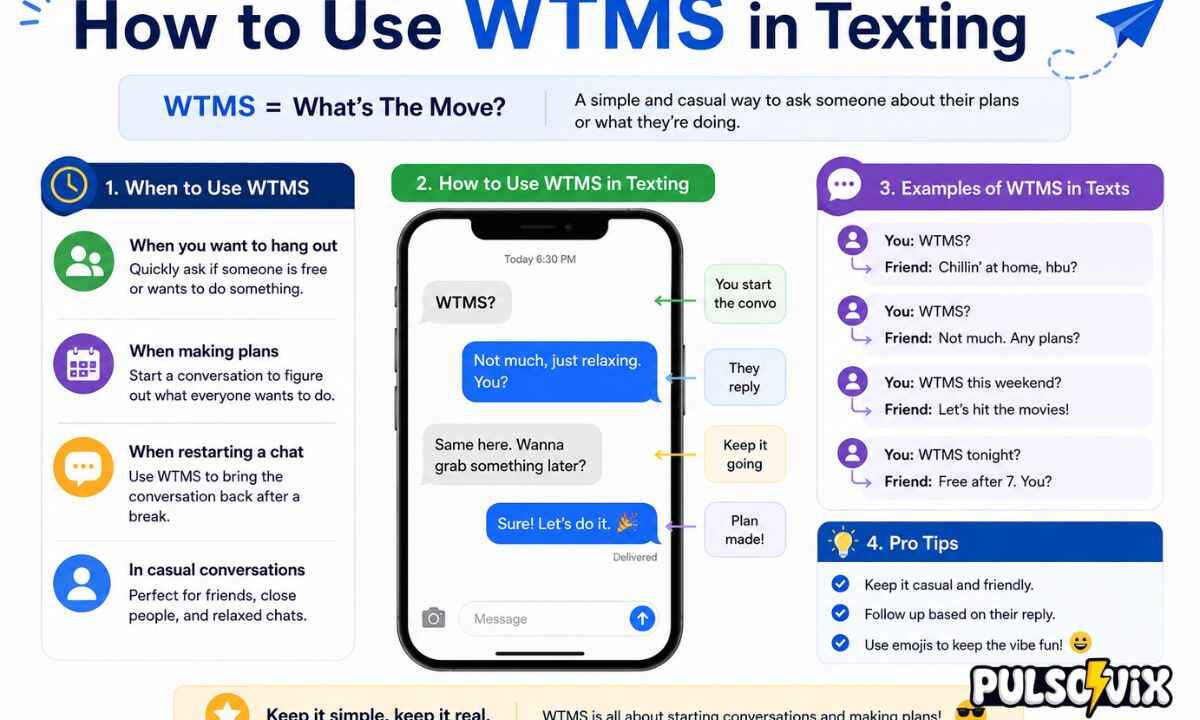
Using WTMS well comes down to a few simple principles:
Do:
- Use it with friends or people you know well
- Match the tone of the conversation (add 😊 for friendly, 😏 for flirty if appropriate)
- Use it when you genuinely want to make plans or check in
- Pair it with context when needed: “WTMS tonight? Tryna eat somewhere new.”
Don’t:
- Use it with strangers or in early-stage conversations unless you’re confident they’ll get it
- Send the flirty version without clear mutual context
- Use it in professional communications
- Assume everyone knows what it means — some people genuinely won’t
If you’re ever unsure whether someone will understand WTMS, just spell it out. Clarity is always better than confusion.
WTMS in Gaming Communities
Gaming communities have adopted WTMS as part of their fast-paced communication style. In environments like Discord, Xbox party chats, or in-game messaging, brevity is king.
Players use WTMS to:
- Quickly coordinate after a loss or win
- Ask about strategy shifts
- Check if the squad is ready to queue
- Plan post-game hangouts
The slang fits naturally into gaming culture’s love of shorthand and efficiency. While “Sis” sometimes gets dropped or modified in gaming contexts, the core question — what’s the plan? — remains.
Flirty Use of WTMS on Dating Apps
On apps like Tinder and Bumble, WTMS has become a go-to opener for people who want to come across as playful without being too forward. It works because it has a built-in ambiguity — it could just mean “what are your plans?” but paired with the right emoji, it hints at something more.
This dual-layer quality is exactly what makes it popular in dating contexts. It gives the sender plausible deniability while still flirting, and it lets the recipient respond at whatever comfort level they choose.
Effective use on dating apps:
- “So WTMS this weekend? 😏” — after a few good exchanges
- “Saw you like hiking too — WTMS Sunday?” — specific, low-pressure invite
- Keep it light; if they don’t know the slang, be ready to clarify naturally
Avoid using it as your very first message to a cold match — lead with something more personalized first.
Common Mistakes and Misconceptions
Even people who know WTMS can trip up. Here are the most common mistakes:
- Wrong context — Using the flirty meaning when the friendly one was intended (or vice versa) causes awkward misunderstandings.
- Wrong audience — Sending WTMS to a coworker, boss, or older family member who won’t understand it.
- Spelling variations — WTNS, WTMD, TMSW are not the same thing. Stick to the correct acronym.
- Overusing it — Like any slang, WTMS loses its casual charm if used in every message.
- Assuming everyone knows it — Always read the room. Not everyone is plugged into Gen Z internet slang.
WTMS vs Other Similar Slang
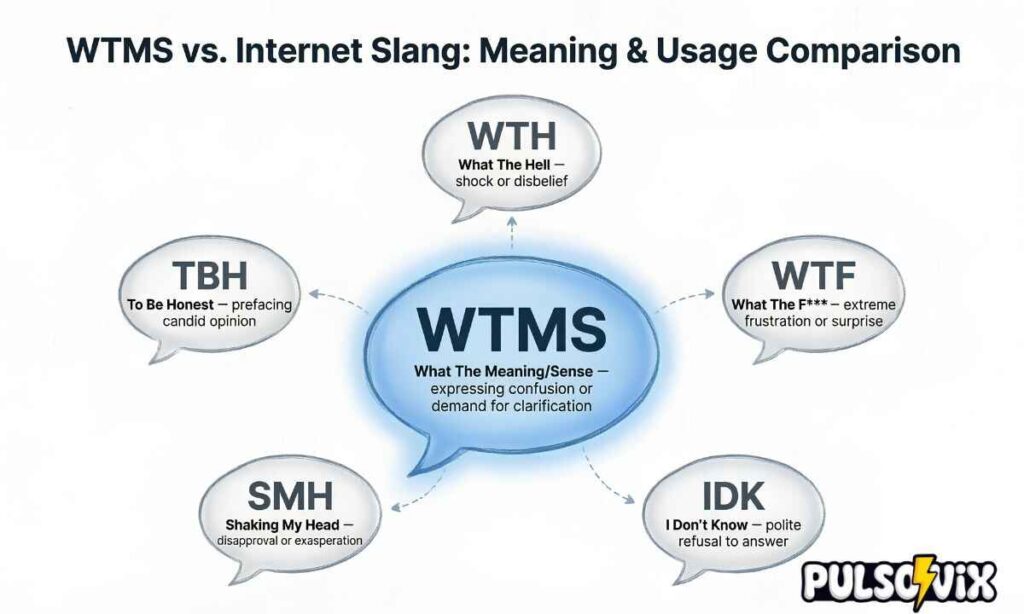
Understanding how WTMS fits into the broader slang landscape helps you use the right phrase at the right time:
| Term | Meaning | When to Use |
| WTMS | What’s the Move, Sis? | Asking close friends about plans |
| WTM | What’s the Move? | Same as WTMS but slightly less personal |
| WYD | What You Doing? | Casual check-in, often with romantic undertone |
| WYA | Where You At? | More urgent; asking location |
| HMU | Hit Me Up | Open invitation to reach out anytime |
| IYKYK | If You Know, You Know | Referencing an inside joke or shared experience |
| NGL | Not Gonna Lie | Preface to honesty |
WTMS sits firmly in the high-warmth, moderate-familiarity zone. It’s warmer than WTM, less urgent than WYA, and more plan-focused than WYD.
Regional and Cultural Insights
The popularity of WTMS varies significantly by region, but its influence is growing globally thanks to TikTok and Instagram:
- US (especially urban areas): Most widespread use; understood by most people under 35
- UK: Known but less commonly used; WTM is more common
- Australia: Occasionally used among users plugged into American internet culture
- Global gaming communities: Used in English regardless of the player’s native language
- Non-English speakers: Generally unfamiliar unless they consume a lot of English-language content
One key cultural note: WTMS, like much of today’s digital slang, has roots in Black American culture and AAVE. As it travels globally, that origin often gets stripped from the conversation. Being aware of that history adds depth to how we engage with language online.
Conclusion
The WTMS meaning in text is straightforward once you know what to look for: it’s primarily “What’s the Move, Sis?” — a warm, casual way to check in on someone’s plans. In flirty or meme-heavy contexts, it shifts to “What That Mouth Do?” — something best saved for people you already have that kind of rapport with.
What makes WTMS interesting isn’t just its meaning but how it reflects the way language works online. It’s efficient, expressive, and deeply rooted in a cultural tradition of making language more human and less formal. Knowing how to read it — and when to use it — puts you solidly in the loop with modern digital communication.
